
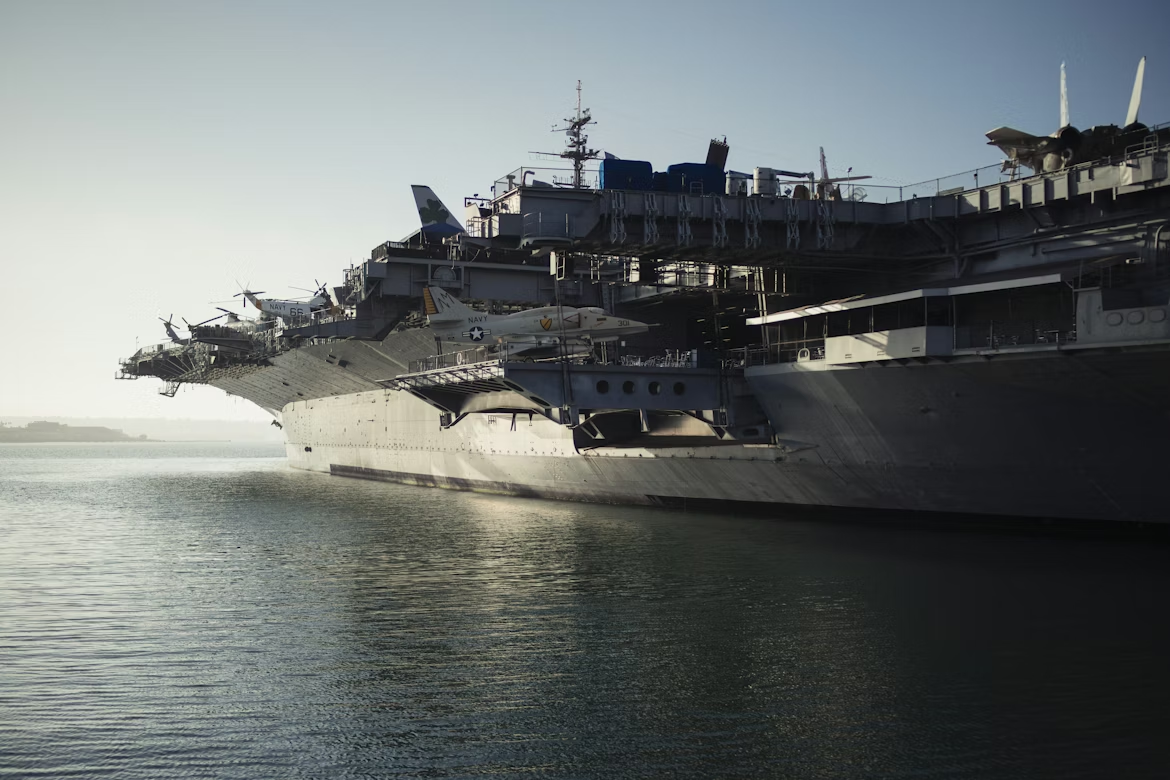
At the start of the conflict, President Trump repeatedly characterised it as a "short-term excursion" that he now claims is nearing its end, while simultaneously emphasising the need for "ultimate victory". On the contrary, U.S. military posture is for escalation: the USS Gerald R. Ford has entered the Red Sea, and the USS George H.W. Bush is preparing for deployment as an additional carrier strike group in the region. Concrete timelines further confused the rhetoric, with reports estimating that the George H.W. Bush requires 10–12 days to reach the eastern Mediterranean, while the Ford's mission parameters suggest an unusually extended deployment window. Compounding the uncertainty, the public lacks a reliable, comprehensive assessment of casualties and damage, as battle-damage evaluation remains tightly controlled, contested and fabricated. While commercial satellite providers like BBC Verify and Bellingcat do have the capability, they have delayed imagery in parts of the region to prevent adversaries from exploiting it. The ball is now in the Iranian court with the emergence of its new supreme leader equipped with motives to either completely obliterate its enemies or make temporary peace.
EQUITY
Wall Street finished higher as the Nasdaq led gains with a late-session rebound after hints of Iran-Israel conflict resolution. While technology and semiconductor stocks like Nvidia and Broadcom rallied, the broader market remained cautious. Looking ahead, the market remains highly sensitive to incoming data, with the Labour Department’s Consumer Price Index report to provide clarity on the Federal Reserve's interest rate path for the first half of 2026.
GOLD
Gold price climbed to $5,185, underpinned by aggressive reserve diversification from central banks in China and India, alongside a weaker US dollar and a ripple effect from a 10% drop in crude oil prices. While shifting Federal Reserve rate expectations have created short-term volatility, market experts note that investors are increasingly "buying the dip" in physical markets to hedge against lingering geopolitical uncertainty.
OIL
Crude's move this week laid bare just how hair-trigger oil markets have become, where prices reached a high of $119.50 on Monday and fell to a low of $83.66 the very next day. One diplomatic phone call between Trump and Putin and a few reassuring words from G7 finance ministers about tapping strategic reserves, and suddenly the market unwinds, though Iraq having slashed output by 70%, Kuwait still under force majeure, and Saudi Arabia trimming production are still major factors to consider.
CURRENCY
The dollar briefly looked like it might finally crack the 100.00 level for the first time since late November, faltering after Trump's comment on Iran killed the safe-haven buzz mid-session. Europe's single currency went nowhere fast, stuck around 1.1634, with Germany's factory orders in freefall and energy costs squeezing the bloc from every angle. Sterling managed a modest recovery, while the yen drifted lower even with better wage data. The yuan quietly outperformed the pack, backed by export numbers and the PBOC setting its strongest midpoint fix since April 2023.